

Timeline
Where we’ve been
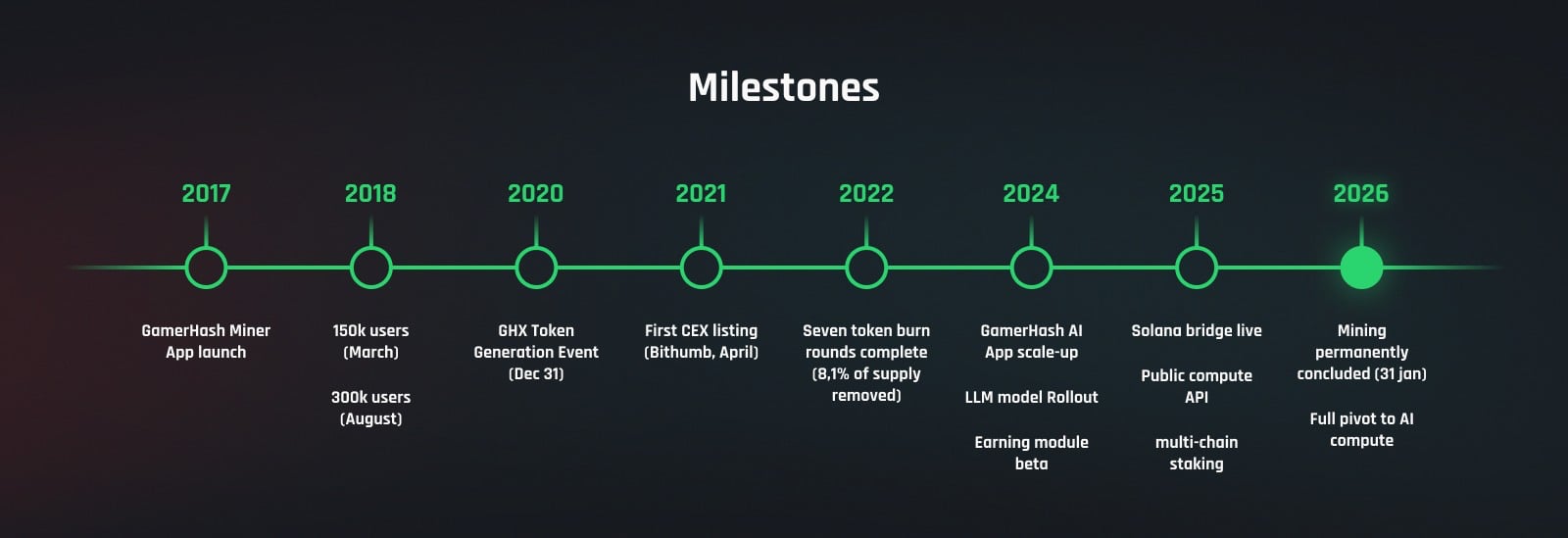
GamerHash launched in November 2017 as a desktop client that paid users for sharing idle GPU time — years before “DePIN” existed as a category, and it has been running ever since. By August 2018 the platform had ~300,000 registered users; today it has more than 820,000. The native token GHX launched at TGE on 31 December 2020, with the first exchange listing on Bithumb in April 2021. Seven burn rounds between December 2021 and June 2022 permanently removed 8.1% of supply. The strategic pivot toward AI compute began as open-source AI models created demand for distributed GPU power outside of crypto mining. Mining was permanently wound down on 31 January 2026 — the platform now monetizes GPU contribution exclusively through AI inference workloads.What shipped recently
Selected highlights from the last 18 months. For full per-quarter delivery logs, see the GamerHash Medium community updates. 2024- GamerHash AI App scaled across image generation (Sana, DreamShaper, Stable Diffusion variants) and LLM deployments (Llama 3.1/3.2, Qwen 2.5, Gemma 2, PHI-4, DeepSeek).
- Earning module entered internal testing.
- Stats page, device map, full website redesign.
- Multi-chain staking & LP: Solana joined Ethereum and BNB Chain.
- Bridge expansion: Ethereum ↔ Solana via deBridge, with a GHX/SOL pool on Raydium.
- Public compute API: the GPU network opened to developers through an OpenAI-compatible API, with a playground covering text-to-image, text-to-speech, image-to-text and video-to-text.
- Video models: image-to-video, text-to-video (LTX-Video, LTX-2.3) running locally on user GPUs.
- GamerHash Mobile: latest iOS support, USDC payouts.
- Mining permanently concluded; platform fully on AI compute.
- LTX-2.3 video generation deployed locally.
- Workflow-automation integrations shipped; deAPI passed one million inference requests a month (July 2026).
- GHXP Seasons replaced GHXP Events (May): commit up to 80% of saved GHXP to a monthly pool, receive GHX pro rata.
- New models in the app: Z-Anime (May) and MiniMax H3 video with native audio (August), running on users’ own GPUs.
- Earn Module: VRAM monitoring (v0.80.0) and speech-to-text jobs (v0.82.0) alongside image and video.
- GamerHash AI Mobile: renamed, with live status of your AI workers.
- Korean localization of the GamerHash site completed.
- New gamercoin.com with Creator Studio and the AI Showcase.
What’s next
Directions, not commitments. Plans change as the work does, and nothing on this page is a promise about GHX supply, price, or rewards.- ✅ Creator Studio for the community — free GHX image, video, and music generation on gamercoin.com. Shipped.
- An agent that runs on the network. An easy-to-use AI agent powered by GamerHash compute.
- Micro-products on the distributed network. Small, focused services built on deAPI and powered by community GPUs — the same pattern as Creator Studio.
- More work for contributed GPUs. New model types in the app and the Earn Module, so connected cards have jobs more of the time.
Long-term direction
Beyond the quarterly plan, four bets shape the longer arc:- One AI app, all open-source models. A single client that runs the most popular open-source models for image, video, voice, and text — locally on the user’s GPU.
- Earning while running. GPU contribution monetized while the user is actively using AI tools, removing the trade-off between use AI and earn from AI.
- Distributed compute network. A global pool of consumer GPUs accessible to AI projects, developers, and enterprises through public APIs.
- Multi-chain GHX. GHX available on Ethereum, BNB Chain, and Solana.
Reference
- GamerHash on Medium — monthly community updates, deep-dives, and announcements.
- Why $GHX isn’t just another token — context on infrastructure-backed economics (Feb 2026).
- From Mining to AI: GamerHash Evolution — the strategic pivot, in the team’s own words.
- GHXP Seasons — How GamerHash Rewards Now Work — the new rewards model (May 2026).
- Community Update — July 2026 and August 2026 — VRAM monitoring, MiniMax H3, speech-to-text in the Earn Module.